The Complete Guide to Luxury Container and Tiny Homes
An honest, in-depth resource for serious buyers. Builder comparisons, what to look for, what to avoid, and everything the sales brochures leave out.
Link Disclosure: Some links on this site are affiliate links — we may earn a commission if you purchase through them, at no additional cost to you. Affiliate status never determines what we include or how we rate it. Full program status →


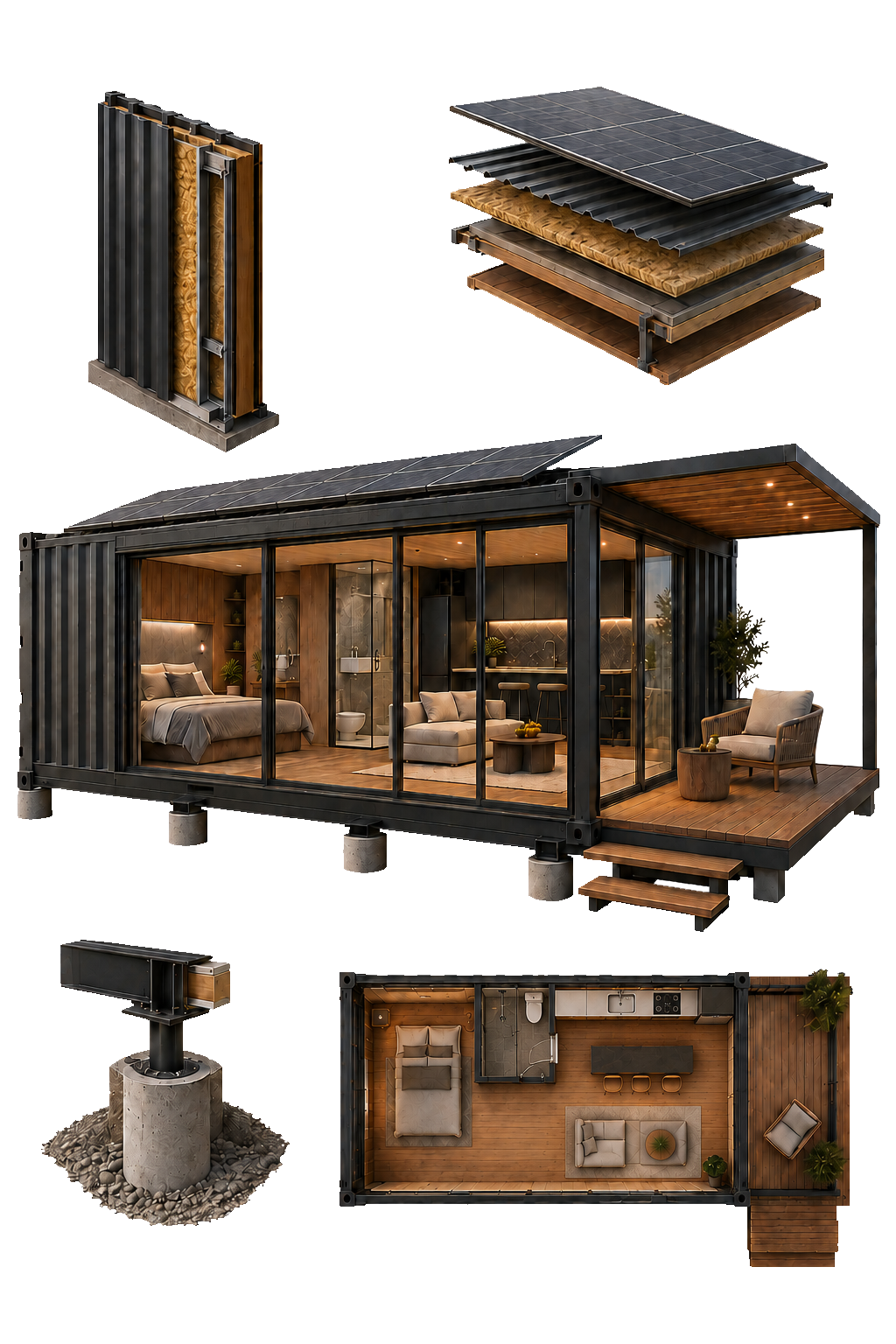
Vaulted wood-lined ceilings and large-format glazing are two of the most repeated design moves across the higher end of this market — both add a sense of volume that raw square footage alone doesn't.
A different kind of home requires a different kind of thinking
The appeal is not just price. It is intentionality — owning a space that reflects exactly what you need and nothing you do not.
Architectural freedom traditional construction rarely allows
Container and tiny home builds accommodate a level of custom design that traditional construction rarely allows at the same price point. Industrial steel, floor-to-ceiling glass, rooftop decks, and open-plan layouts that would be prohibitively expensive in a conventional build are standard possibilities here — the constraint is thoughtfulness, not budget.
Lower Financial Commitment
At $25,000 to $165,000 for a complete structure, many buyers pay cash, eliminating mortgage interest. Ongoing costs run substantially lower than a comparably positioned traditional home.
Flexibility of Placement
A foundation offers the permanence of traditional real estate. Wheels offer something traditional homes cannot: the ability to move with your circumstances.
Ready to see how the top builders actually compare?
Browse BuildersWhat the brochures do not tell you
The container and tiny home market has grown significantly in the last decade, and with that growth has come a wider range of builders, from highly reputable craftspeople with decades of experience to newer operations that overpromise and underdeliver. Knowing how to evaluate a builder is the most important skill you can develop before you spend a dollar.
The first thing to understand is that a quoted price rarely includes everything you will ultimately pay. Site preparation, foundation work, utility connections, permits, inspections, and delivery can add 20% to 50% on top of the structure price depending on your location, per our cost research. A builder who quotes you $60,000 for a home that costs $90,000 by the time it is livable is not being dishonest about the structure, but the total cost picture is incomplete.
"The structure is only the beginning. What you are really buying is the process: the builder's communication, their warranty, their experience navigating your specific site conditions."
What separates a good build from a stressful oneContainer Homes vs. Tiny Homes on Wheels
These are distinct categories with different practical profiles. A shipping container home is built from repurposed 20 or 40-foot steel containers. They are structurally very strong, inherently modular (two or more containers can be joined), and typically placed on a permanent or semi-permanent foundation. They tend toward an industrial aesthetic that lends itself well to modern and minimalist design directions.
A tiny home on wheels (THOW) is purpose-built on a trailer chassis. The on-wheels format means it can be registered as an RV in most jurisdictions, which simplifies the regulatory picture significantly. The trade-off is that on-wheels homes face more constraints on size and weight, and must be parked somewhere that permits them, which varies widely by location. See our full tiny house vs. RV comparison for how certification affects financing and insurance.
For buyers who want a permanent placement with architectural impact, container homes are the stronger choice. For buyers who want flexibility of location or a lower entry price with simpler permitting, a tiny home on wheels may be more practical. Both are legitimate and compelling options — the right choice depends on your specific situation.

Wood-clad exteriors like this remain the most common styling choice for tiny homes on wheels, favored for weight and cost over metal or masonry cladding.
What to Look for in a Builder
Ask any builder you are considering for references from completed projects, not just testimonials on their website. Ask to speak with past clients directly. Ask the builder what their warranty covers and for how long. Ask who handles permitting — some builders manage this, others leave it entirely to the buyer. Ask what the timeline looks like from deposit to delivery and get that estimate in writing.
A reputable builder answers all of these questions clearly and promptly. One who deflects, gives vague answers, or makes you feel like you are being difficult for asking is telling you something important about how they will communicate once you have paid a deposit.
"The best time to find out a builder is difficult to work with is before you've sent a deposit — not after."
A recurring theme in the complaints we reviewed while researching this guideBuilders and resources worth considering
There is no charge to use this comparison. Product, plan, construction, and service costs are set by each provider. Detail below is based on our research of each company's published information as of July 2026. Always verify current details directly with the builder before making decisions. See our best-for guide if you want a quicker recommendation by use case.


Container and tiny home interiors increasingly favor warm wood tones over the cold, industrial look often associated with shipping-container construction.
| Builder | Type | Price Range | Service Area | Customization | Certification | Warranty | Financing | Best For | Advantage | Drawback | Verified |
|---|---|---|---|---|---|---|---|---|---|---|---|
| Craftsman Tiny Homes | Modular ADU / custom builder | $82,900–$165,900 for Summit modular line (per company site); third-party listings cite a wider $25K–$165K range across models | Florida and Georgia (per third-party source; not confirmed on company site) | Custom builds plus configurable Summit modular line | Reported HUD-compliant modular construction (per third-party source, unconfirmed by us) | Not published; confirm directly | Financing application mentioned on-site; third-party source cites a lender program | Buyers wanting a permanently placed modular ADU | Wide price range from entry-level to modular | Warranty terms and exact service area not independently confirmed | July 2026 |
| Texas Tiny Homes | Digital home plans | $299–$1,499 per plan (per company site) | Digital delivery; usable anywhere with a local builder | Custom elevation and rendering changes available for a fee | Not applicable (plans, not a certified structure) | Not applicable | Not applicable | Buyers who want to build with their own local contractor | Large catalog spanning tiny to mid-size plans; company founded 2012 | Buyer sources their own builder and permits separately | July 2026 |
| Tiny Home Builders | Education: plans, books, workshops | Not independently verified; priced per item on their site | In-person workshops at specific locations and dates; online workshop nationwide | Plans include editable SketchUp files | Not applicable | Not applicable | Not applicable | Buyers still in the research and education phase | Long operating history; both in-person and online formats | Not a builder — construction still sourced independently | July 2026 |
| The Tiny Project | Digital home plans (single design) | Historically $150–$250 per set (confirm current price) | Digital delivery, nationwide | Includes an editable SketchUp model | Not applicable | Not applicable | Not applicable | Buyers drawn to one specific, well-documented modern design | Plans are based on an actual built, lived-in home with a design award | Single core design rather than a large catalog | July 2026 |
| Truoba House Plans | Architectural plans (broader modern catalog) | Not independently verified | Digital delivery; company based in Lithuania, serves international customers | Fully customizable with a reported 48-hour customization quote turnaround | Reports applying Passive House energy-efficiency principles | Not applicable | Not applicable | Buyers wanting modern/minimalist styling beyond typical tiny-home catalogs | Large catalog and strong customization process | Not a tiny-home specialist; most plans are larger homes | July 2026 |
Sourced from each company's own website as of July 2026, with third-party listings noted where used. Prices, service areas, and terms are set by each company and change without notice to us — confirm current details directly before making a decision. See our Research Methodology for how we compile this table.
Craftsman Tiny Homes
According to the company's website, Craftsman Tiny Homes offers a modular Summit line starting at $82,900 for a 410 sq ft unit and $165,900 for an 800 sq ft unit, positioned as suitable for primary residences, guest houses, and short-term rental units. A third-party source places the company in Florida and Georgia and describes additional lower-cost Bunk models, which we have not confirmed directly. We have not independently verified warranty terms or exact service area — confirm both directly with the builder. Read our full review for the complete model lineup and what we found in customer feedback.
View Craftsman Tiny Homes →Contact the builder directly for current pricing, warranty terms, and delivery timelines specific to your location.
Texas Tiny Homes Plans
According to the company's website, Texas Tiny Homes was founded in 2012 and sells digital tiny, small, and mid-size home plans ranging from $299 to $1,499, delivered instantly and intended to be used with a local contractor or builder. Custom elevation and rendering changes are available for an additional hourly fee. Confirm the current catalog and pricing directly on their site. Read our full review for company background and what we could and couldn't independently verify.
Browse Texas Tiny Home Plans → Affiliate link — we may earn a commissionPlans arrive instantly after purchase, so you can start reviewing them with a contractor the same day.
Tiny Home Builders
Based on our research, Tiny Home Builders has offered books, construction plans, and workshops for over a decade, covering topics such as foundations, plumbing, and electrical systems, aimed at people in the research and planning phase of a tiny home project. They offer both in-person hands-on workshops and an online workshop format. Confirm current schedules and offerings directly on their site. Read our full review for the company's origin story and what we found in customer feedback.
Explore Tiny Home Builders → Affiliate link — we may earn a commissionWorkshops run several times a year and are a low-commitment way to get hands-on before you buy or build.
The Tiny Project
The Tiny Project is a single, well-documented modern tiny house design by Alek Lisefski, who built and lived in the original 160 sq ft home. According to the company's site, the plans have historically been priced between $150 and $250 and include an editable SketchUp model. The design won a Sunset Magazine award, per a third-party source. Confirm the current price directly, as it changes with periodic sales. Read our full review for the independent press coverage behind this design.
Browse The Tiny Project → Affiliate link — we may earn a commissionPlans are for a single core design rather than a large catalog — a good fit if this specific style matches your taste.
Truoba House Plans
According to the company's website, Truoba is a Lithuania-based architectural plans studio offering a large catalog of modern and minimalist home designs, most sized larger than a typical tiny home. They report a 48-hour turnaround on customization quotes and apply Passive House energy-efficiency principles to their designs. A good next stop if you want distinctive styling and don't mind filtering a larger-home catalog down to a smaller footprint. Read our full review, including their exceptionally strong 120+ review Trustpilot record.
Browse Truoba House Plans → Affiliate link — we may earn a commissionPlans are downloadable and licensed for use with any local builder or contractor.
Luxe Box Properties
Once you have found the right home, the next question is where to put it. Luxe Box Properties covers the property and land side of the equation: zoning considerations, utility hookups, tiny home communities, and the investment potential of container and tiny homes as short-term rentals. The sister site to this one, built around the same commitment to honest, thorough information.
Visit Luxe Box Properties →The land and placement guide for container and tiny home buyers.
The Luxury Tiny Home Buyer's Checklist
Seven things to confirm before you commit to any builder or purchase. This checklist reflects what experienced buyers wish they had asked earlier in the process.
Verify zoning and permitting requirements for your placement location
Before you fall in love with a home, confirm that your intended site is legally approved for it. Zoning rules for tiny homes and container homes vary dramatically by county and municipality. This step should happen before you contact any builder.
Get a fully itemized quote that includes delivery, site prep, and utility connections
The structure price is rarely the total cost. Ask every builder for a complete breakdown including delivery to your site, foundation or blocking, and utility hookup costs. Compare quotes on this all-in basis, not just the structure alone.
Request references from completed projects and contact them directly
Any reputable builder should be able to provide at least three references from buyers whose homes have been completed and lived in for six months or more. Speak with those people directly, not through the builder as an intermediary.
Understand the warranty terms in writing before paying a deposit
Ask specifically what the warranty covers, for how long, and what process is required to make a warranty claim. Get this in writing before you pay anything. A verbal assurance is worth nothing once a dispute arises.
Clarify who handles permits and inspections
Some builders manage permitting as part of their process. Others treat it as entirely your responsibility. Know which applies before you sign. If you are managing permits yourself, research the process for your specific jurisdiction before committing to a timeline.
Explore your financing options before you need them
Tiny homes and container homes rarely qualify for conventional mortgages. Research personal loans, RV loans (for homes on wheels), chattel loans, and construction loans well before you are ready to sign — lenders familiar with this category are not as common as those who handle traditional real estate.
Review the purchase agreement with a real estate attorney
A home purchase at any price point is a significant financial commitment. Have any purchase agreement reviewed by an attorney familiar with your state's construction and consumer protection laws before you sign. The cost of legal review is minimal compared to the cost of a dispute.
Checked every box? Meet the builders that clear the bar.
Browse BuildersWhat people get wrong about tiny and container homes
These come up in almost every conversation about this category. Getting them right saves time and avoids expensive surprises.
"Tiny homes and container homes are a temporary or low-quality housing option."
The quality ceiling for container and tiny homes is as high as any traditional construction — it depends entirely on the builder and the materials specified. Custom container homes with engineered hardwood floors, high-end appliances, smart home systems, and architectural steel detailing are genuine luxury builds. The category has expanded well beyond the budget-conscious origins that shaped its early public perception.
"You can place a tiny home or container home anywhere you own land."
Land ownership does not override zoning law. Many jurisdictions prohibit tiny homes as primary residences, restrict container structures, or limit dwellings based on minimum square footage requirements. Some areas are tiny-home friendly with clear pathways to approval. Others are effectively closed to this type of structure. Always verify local zoning before purchasing a home or land with the intention of combining them.
"The quoted price is what you will pay."
The structure price is rarely the all-in cost. Delivery to your site, foundation or blocking, utility connections (water, sewer or septic, electricity), site grading, permits, and inspections are frequently additional, and the combined total of these additions can be substantial depending on your location and site conditions. Always request a fully itemized quote that accounts for everything required to make the home livable at your specific placement site.
Questions buyers ask most often
Found your home? Now find the right place for it.
Luxe Box Properties covers the land and placement side of container and tiny home ownership: zoning considerations, tiny home communities, utility planning, and the investment potential of placing your home as a short-term rental.
Visit Luxe Box PropertiesYour ideal home is already being built somewhere. Make sure it is being built for you.
Start with a builder who has the track record to match your expectations. The checklist above costs you nothing to use. The research takes a weekend. The decision lasts decades.